Transactional Email System Integration: Confirmations That Actually Arrive
Customers complain that order confirmations never arrive. Shared mailbox SMTP and marketing tools are the wrong pipe for critical app email. A dedicated email API with delivery analytics stops lost orders and support tickets.
We build the transactional send path your product already assumes exists.
Sound Familiar?
These are the exact issues our clients faced before a proper transactional email system:
- Customers call support saying their order confirmation never arrived, even though your system says it was sent
- Password reset emails land in spam or bounce silently, locking users out and driving ticket volume
- Transactional mail shares an IP or domain with marketing campaigns, so promotions poison confirmation delivery
- Nobody can see bounce, open, or spam-complaint rates for order receipts, so failures only surface when customers complain
- Finance and ops still rely on shared mailbox SMTP or a marketing tool as the pipe for critical app email
Gmail and Yahoo now enforce bulk-sender rules for domains sending 5,000 or more messages a day to personal inboxes. SPF, DKIM, and a DMARC record are mandatory, and spam complaints must stay under 0.3%. From late 2025 Gmail has been delaying or rejecting non-compliant bulk mail. Shared SMTP and unauthenticated marketing pipes are no longer safe for order confirmation emails.
What the Email API Integration Actually Does
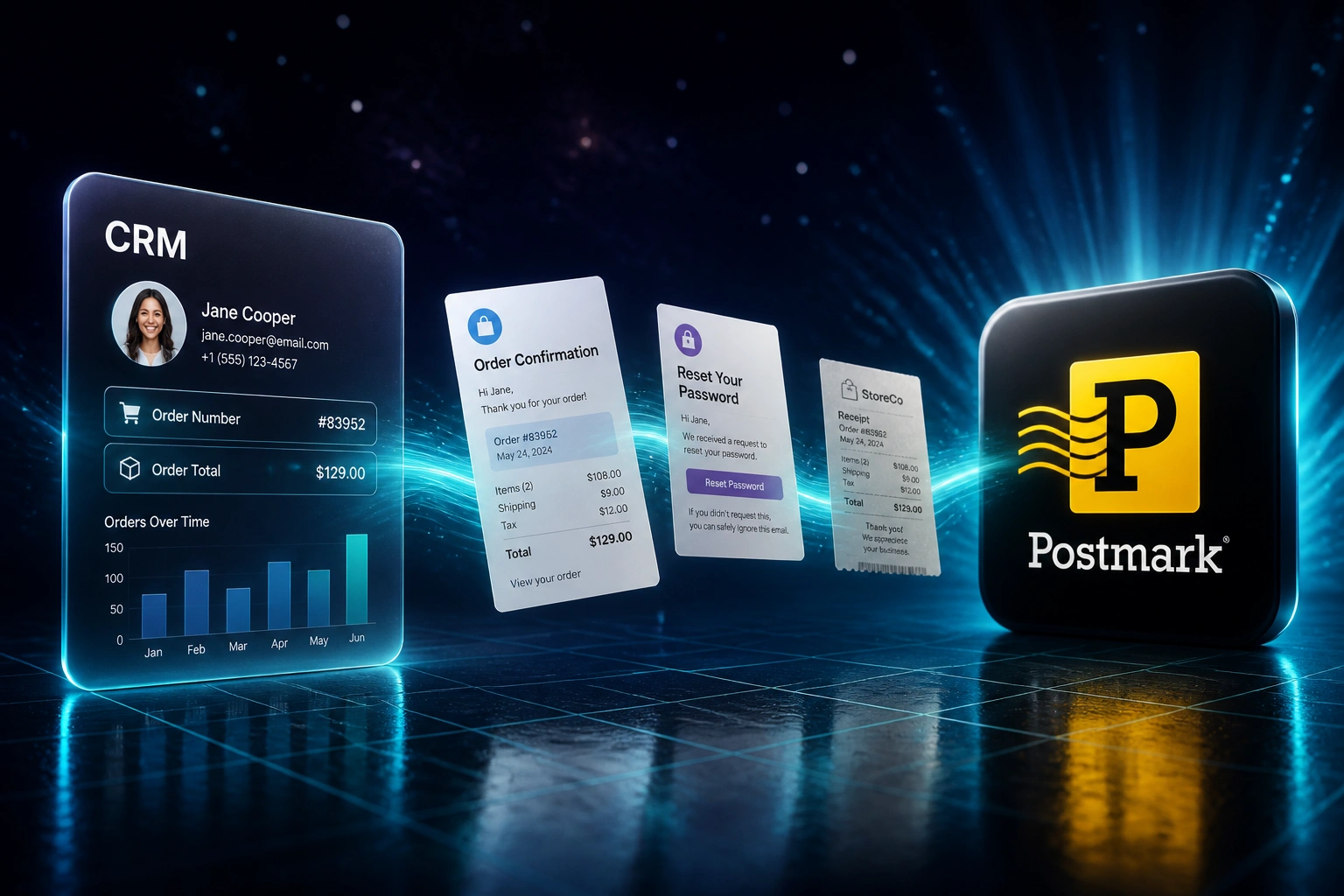
App event fires → authenticated send → delivery logged → failures alerted. No silent black hole.
Event Fires in App or CRM
Order paid, password reset requested, or receipt generated in your commerce stack or CRM
Template Sent via Email API
SendGrid, Postmark, SES, or Resend sends the authenticated transactional message
Delivery Events Logged
Delivered, bounced, delayed, or complained status writes back for ops visibility
Failures Raise Alerts
Hard bounces open a task; soft failures retry so confirmations stop vanishing silently
Everything You Need for Reliable Transactional Delivery
Dedicated Transactional Email API
Order confirmations, password resets, and receipts send through SendGrid, Postmark, Amazon SES, or Resend, not through a shared mailbox or marketing ESP.
Delivery and Bounce Analytics
Every send logs delivered, bounced, delayed, or complained. Ops sees inbox reach before customers open a ticket.
SPF, DKIM, and DMARC Alignment
Authenticated sending domains so Gmail and Yahoo treat your transactional mail as legitimate, not bulk junk.
Separated Reputation Streams
Transactional traffic stays off marketing IP pools. A newsletter spike cannot drag order confirmations into spam.
CRM and App Event Triggers
Checkout completed, password reset requested, or receipt generated fires the right template with merge fields from your CRM or commerce stack.
Failure Alerts and Retries
Hard bounces open a support or ops task with the failed address. Soft failures retry so a full mailbox does not silently kill a confirmation.
Email APIs and Platforms We've Wired
From 60 Delivery Tickets a Month to 12
How a mid-size online retailer stopped order confirmation emails vanishing into spam and recovered R214,000 in year one.
The Shared SMTP Path
- Order confirmations and password resets left through Office 365 SMTP and a marketing ESP
- No bounce or delivery dashboard, so failures only appeared when customers called
- About 60 "I never got my confirmation" tickets every month
- Support spent roughly 10 hours a week re-sending receipts and unlocking accounts
- Marketing campaigns on the same domain kept dragging transactional reputation down
The Transactional Email API
- Checkout, reset, and receipt events fire authenticated sends via Postmark
- Delivery, bounce, and complaint events visible in a shared ops dashboard
- Missing-confirmation tickets fell to about 12 a month
- Support re-send work dropped to under 2 hours a week
- Transactional stream fully separated from marketing IP and domain reputation
Before vs After Email API Integration
How It Works
From first conversation to live transactional delivery in 2 to 4 weeks.
Audit Your Send Path
Where confirmations, resets, and receipts leave today, which domains and IPs they use, and where delivery visibility is missing.
Free Scoping Call
30-minute call to pick the email API, map event triggers, and design authentication and bounce handling.
Build and Parallel Test
We wire your app or CRM to the transactional API, authenticate the domain, and dry-run against live events without emailing every customer.
Go Live and Monitor
Critical mail switches to the new pipe. We watch delivery, bounce, and complaint rates through the first full week of traffic.
Frequently Asked Questions
How is a transactional email API different from our marketing tool?
Marketing tools optimise for campaigns, list hygiene, and unsubscribe. Transactional email APIs (SendGrid, Postmark, Amazon SES, Resend) are built for triggered messages that must arrive: order confirmations, password resets, and receipts. Mixing both on the same reputation is the most common reason confirmations land in spam.
Will this replace our CRM or ecommerce platform?
No. Your CRM, Shopify store, or custom app stays the source of truth. We connect the events those systems already produce to an authenticated email API with delivery analytics. Customers keep using the same product; the send path behind it becomes reliable.
Which platforms can trigger transactional email?
We have wired SendGrid, Postmark, Amazon SES, Resend, and Mailgun from Shopify, WooCommerce, HubSpot, and custom apps. If your system can emit an order, reset, or receipt event via API or webhook, we can send from it.
Do we need this if we already send from Office 365 or Gmail SMTP?
Shared mailbox SMTP is the wrong pipe for volume transactional mail. There is no delivery dashboard, reputation is tied to your office domain, and Gmail now rejects or delays bulk senders that lack SPF, DKIM, and DMARC. A dedicated email API gives you authentication, analytics, and a reputation stream built for app email.
How long does a transactional email system take to go live?
A focused send path for confirmations, resets, and receipts typically takes 2 to 4 weeks from scoping to go-live. Domain authentication and parallel testing are built into that window. Broader multi-brand or multi-region setups sit closer to 4 to 6 weeks.
How much does transactional email system integration cost?
Straightforward one-way API wiring with authenticated domains starts from around R18,000. Builds with bounce alerting, CRM event triggers, delivery dashboards, and multi-template streams typically range from R28,000 to R55,000. Most clients recover the cost within one or two months by cutting "never got my email" tickets and support hours.
Stop Losing Orders to Silent Email Failures
If customers are still telling you the confirmation never arrived, you are paying for a pipe that was never built for transactional email.
Tell us how confirmations, password resets, and receipts leave your stack today. We will show you what a dedicated email API with delivery analytics would change for support volume and customer trust.