Warehouse Management System Integration: Receiving to Ship at Scale
Your warehouse still runs on spreadsheets and WhatsApp photos of shelves. Order volume is up, mis-picks are climbing, and inventory accuracy collapses every time the sheet lags the floor.
We build the WMS integration that organises receiving, storage, pick, and ship, synced to your store and ERP.
Sound Familiar?
These are the exact issues ops directors and ecommerce founders faced before WMS integration:
- Stock truth lives in a shared spreadsheet that is already hours behind the floor
- Receiving is logged on paper, then WhatsApp photos of shelves become the putaway record
- Pickers hunt by memory or sticky notes because bin locations are not system-directed
- Mis-picks and short ships climb as order volume grows, and nobody can prove where the fault started
- Shopify or WooCommerce shows sellable stock that does not match what is actually on the rack
Order volume growth breaks spreadsheet warehouses first. Industry figures put paper picking error rates in a 1–3% band, and mid-market distribution centres commonly lose R6.4M–R9.6M a year to mis-picks at scale. That is rework, returns, and lost trust once you are shipping hundreds of orders a day.
What Warehouse Management Integration Actually Does
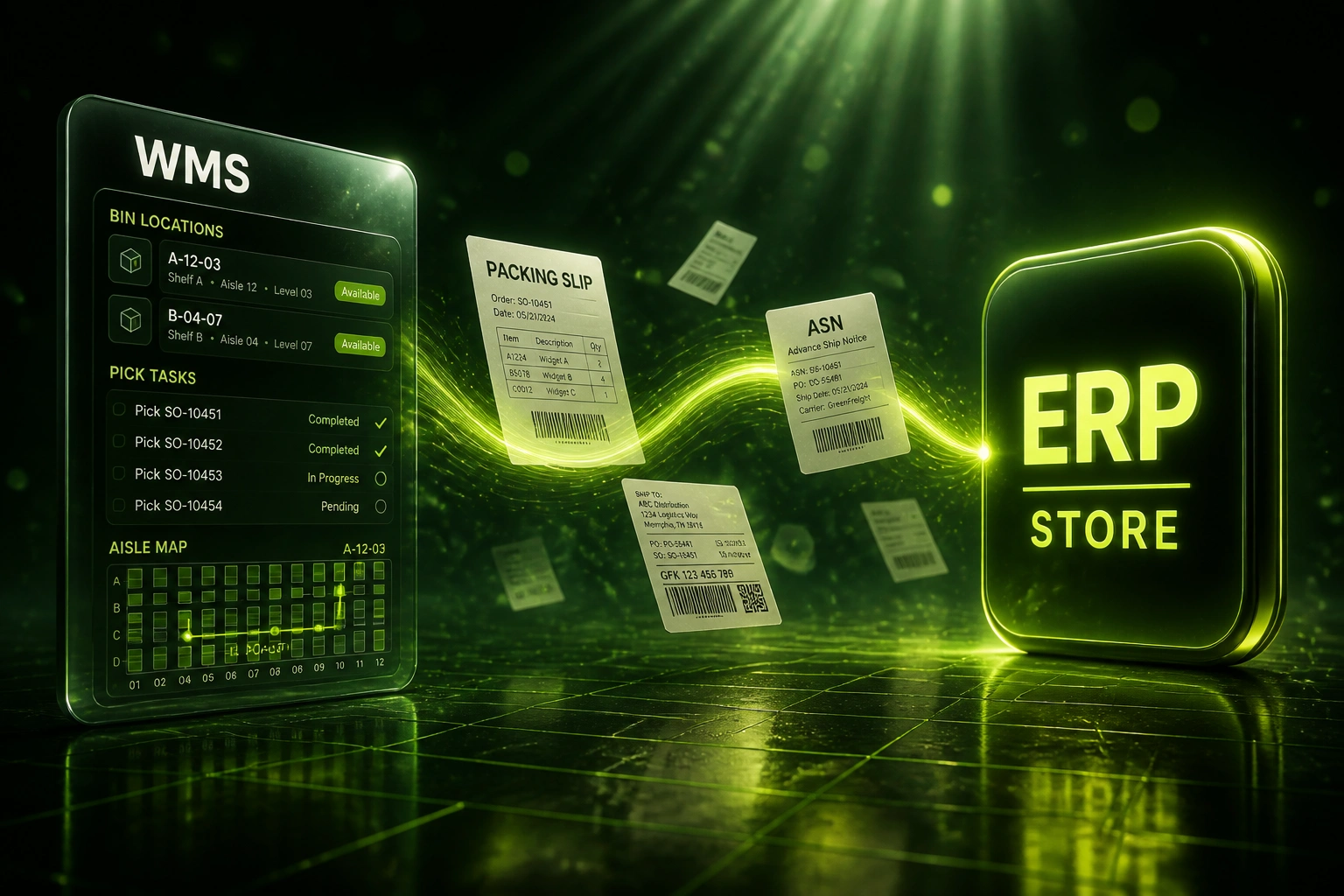
Receive → put away → pick → ship. One system of record, synced to the storefront and ERP.
Goods Arrive
ASN or PO receipt is scan-confirmed; quantity and SKU exceptions raise on the dock
Directed Putaway
WMS assigns bin locations; stock becomes available in the storefront once confirmed
Pick & Pack
Orders become directed pick tasks; pack confirmation gates wrong SKUs before labels print
Ship & Sync Back
Dispatch updates Shopify, WooCommerce, or ERP with stock and fulfilment status in real time
Everything You Need for a Reliable Warehouse System
Directed Receiving & Putaway
ASN or PO receipt scans confirm quantity and SKU, then the WMS assigns bin locations so putaway is directed, not guessed.
Bin Location Master
Every SKU has a home. Slotting rules, bin capacity, and location barcodes keep storage accurate as volume scales.
Directed Pick Tasks
Ecommerce and ERP orders become path-optimised pick tasks on handhelds. No printed sheets, no tribal aisle knowledge.
Pack & Ship Confirmation
Pack gates and ship confirmation update the WMS and push tracking and fulfilment status back to Shopify, WooCommerce, or ERP.
Real-Time Inventory Sync
Receipts, picks, adjustments, and shipments write available-to-sell stock back to the storefront so oversells collapse.
Exception & Audit Trail
Short receipts, damaged stock, and scan mismatches raise exceptions with a timestamped trail from dock to dispatch.
Platforms We've Connected Around Warehouse Ops
From Spreadsheet Chaos to 99.7% Pick Accuracy
How a Johannesburg ecommerce warehouse stopped running stock on WhatsApp photos and cut mis-picks from 2% to under 0.3%.
The Manual Process
- Receiving logged in Excel; putaway noted with phone photos of aisles
- Pickers worked from printed sheets printed hours after Shopify orders landed
- About 2% of orders needed a reship or credit for wrong or missing items
- Storefront available-to-sell drifted within hours of any busy intake day
- Ops director spent evenings reconciling sheet counts to physical racks
The Integrated WMS
- ASN scan at the dock, directed putaway to labelled bins
- Shopify orders become handheld pick tasks with scan confirmation
- Mis-picks fell below 0.3%; pack gate stops wrong SKUs before labels print
- Available-to-sell updates as receipts and picks confirm
- Exception queue shows short receipts and scan fails without reconstructing a paper trail
Before vs After WMS Integration
How It Works
From first floor walk to live warehouse management integration in 4–8 weeks.
Walk the Floor
How receiving, putaway, picking, and shipping work today, and where spreadsheets and WhatsApp photos create lag.
Free Scoping Call
30-minute call to map bin structure, scan points, storefront sync, and which WMS or warehouse stack fits your volume.
Build & Pilot
We integrate receiving through ship, pilot on one product family, and compare accuracy and cycle time against the spreadsheet baseline.
Go Live & Monitor
Cut over from spreadsheets. Dashboards track inventory accuracy, mis-picks, picks per hour, and storefront stock lag.
Frequently Asked Questions
How long does a warehouse management system integration take?
A focused WMS integration covering receiving, bin-directed putaway, pick tasks, and storefront or ERP sync typically takes 4–8 weeks from scoping to go-live. A single-site pilot on one order profile can be live sooner. Multi-warehouse, ASN EDI, and deep ERP accounting hooks take closer to 8–12 weeks.
How is this different from pick-pack-ship or fulfilment automation?
Pick-pack-ship and fulfilment automation cover slices of the floor: directed picks, pack gates, wave release, and courier handoff. WMS integration is the broader system of record for warehouse ops: receiving, putaway, bin locations, inventory accuracy, picking, packing, and shipping, kept in sync with Shopify, WooCommerce, or ERP. Those workflows often sit on top of the WMS once it is live.
Do we need to buy a specific WMS product first?
Not always. Some South African ecommerce teams start with scan-directed warehouse workflows wired to Shopify or WooCommerce. Others already run a WMS and need it connected properly to the storefront and ERP. We scope either path: select and integrate a WMS, or integrate the one you already own.
Will this disrupt the floor during rollout?
We run parallel so receiving and picking can use the new flow beside the old spreadsheet process before cutover. Go-live is usually mid-week outside a promo peak, with floor leads trained on exceptions first.
What accuracy and productivity should we expect?
Paper and spreadsheet warehouses commonly sit in a 1–3% picking error band and 60–80 picks per hour. Mobile, scan-directed WMS picking routinely pushes accuracy toward 99.5% and above and 120–150 picks per hour. Inventory accuracy of 99% or higher is the industry benchmark once receipts and picks are scan-confirmed.
How much does WMS integration cost?
Integrating an existing WMS to Shopify or WooCommerce with receiving and pick sync starts from around R40,000. A fuller build covering putaway rules, bin masters, pack confirmation, and ERP stock sync typically ranges from R60,000 to R120,000. Mid-volume warehouses often see payback inside 6–12 months from mis-pick, labour, and oversell savings alone.
Stop Running Warehouse Ops on Spreadsheets
If receiving, storage, picking, and shipping still depend on Excel and WhatsApp photos, you are paying for mis-picks and inventory lag every day volume grows.
Tell us how stock arrives today, which storefront or ERP you run, and where accuracy breaks first. We will show you how a warehouse management system integration would organise the floor at your scale.