World-Check Case Management: Streamline Hit Review and Escalation Workflows
Your screening finds the hits. Then they sit in email and spreadsheets while analysts burn out and onboarding stalls. Unstructured screening hit review creates regulatory exposure the moment an examiner asks who decided what.
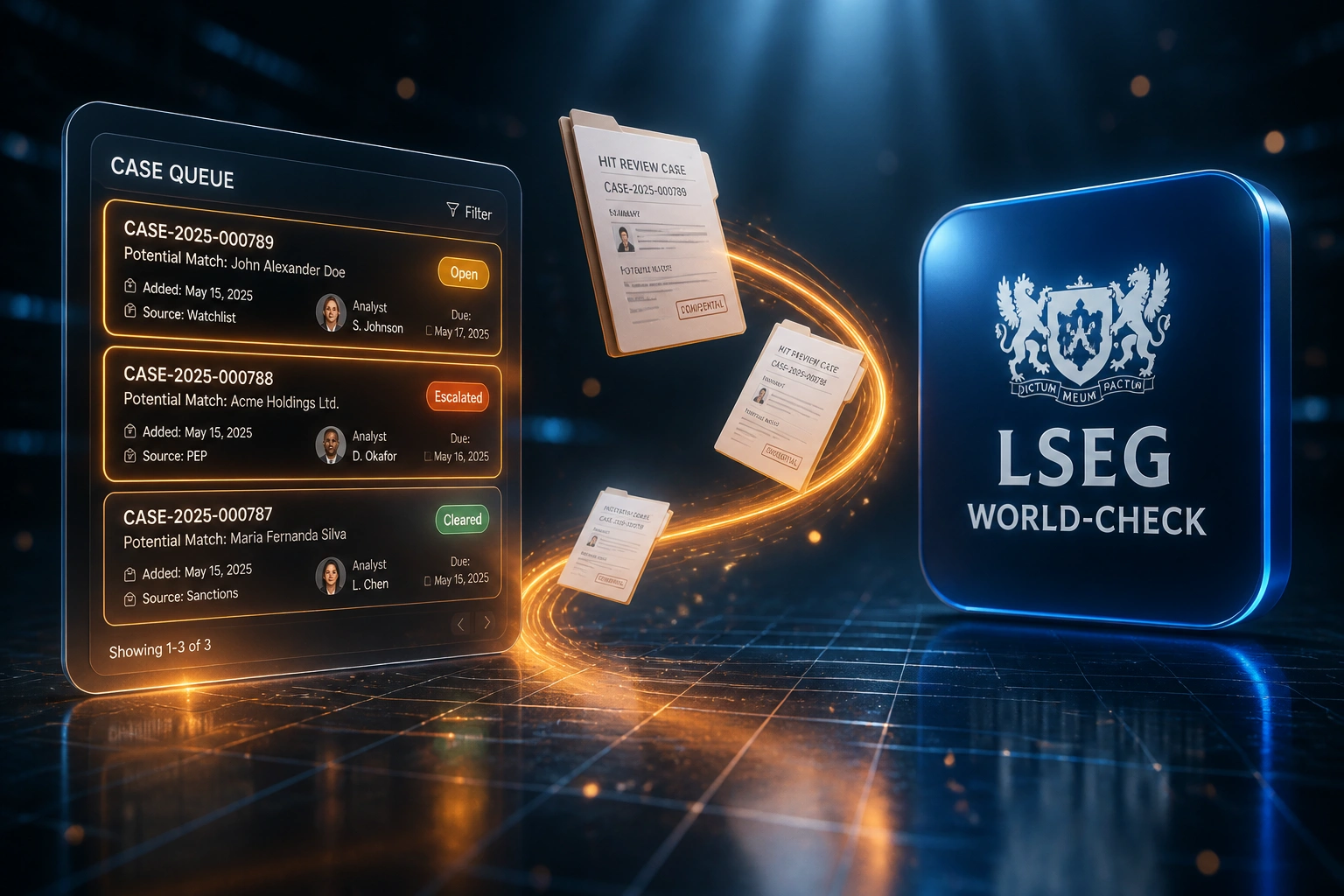
We build the compliance workflow that routes, escalates, decides, and proves every World-Check case.
Sound Familiar?
These are the exact issues our clients faced before structured case management:
- World-Check hits land in inboxes and spreadsheets with no owner, SLA, or escalation path
- Analysts burn 30–45 minutes per alert, while 85–95% of hits clear as false positives
- Nobody can prove who cleared a match, when, or why when FSCA or FIC examiners ask
- Onboarding stalls for days while hit review sits in a shared mailbox backlog
- Junior analysts clear on reflex under volume pressure, and true matches risk being missed
Global sanctions designations rose 17.1% year on year to 79,830 by March 2025 (LSEG Global Sanctions Index). Hit volumes climb while FSCA inspections increasingly demand documented, step-by-step screening decisions, not reconstructed email threads.
What the Compliance Workflow Actually Does
Hit arrives → case opens → analyst decides → audit trail locked. No human hunting through inboxes.
Hit Becomes a Case
World-Check match opens a queued case with owner, priority, and SLA clock
Analyst Reviews
Secondary identifiers and match detail sit beside the client record for fast disposition
Escalate or Decide
Clear, false positive, or World-Check escalation to MLRO with rationale required
Audit Trail Locked
Decision, evidence, and timestamps sync back so onboarding can move and examiners can see
Everything You Need for Structured Hit Review
Structured Case Queues
Every World-Check screening hit opens a case with owner, priority, and SLA. No more hunting through email threads for the next alert to review.
Analyst Routing Rules
Route hit review by risk tier, product line, or jurisdiction. Senior analysts see escalations; Level 1 clears the noise against clear resolution criteria.
Escalation Ladders
Potential matches auto-escalate to the MLRO or head of risk with evidence already attached. Deadlines and reminders keep World-Check escalation from going cold.
Decision Capture
Clear, false positive, or escalate with mandatory rationale and supporting identifiers. The disposition sticks to the client record for every screening hit review.
Inspection-Ready Audit Trail
Who opened the case, what they compared, who decided, and when. Built for FSCA and FIC examinations that demand step-by-step evidence, not reconstructed email chains.
Onboarding Sync-Back
Cleared cases release the client back into your CRM or loan system. Blocked or escalated cases pause take-on until compliance signs off.
Systems We've Wired Into Case Management
From 4.2 Days to 6 Hours Mean Time to Clear
How a mid-size South African wealth manager stopped drowning in World-Check hits and walked into an FSCA inspection with a complete audit trail.
The Spreadsheet Process
- Hits forwarded from World-Check into a shared mailbox and Excel tracker
- 38 hours a week across three analysts clearing screening hit review by hand
- Mean time to clear: 4.2 business days, with onboarding blocked the whole time
- No reliable record of who decided, when, or which secondary identifiers were compared
- MLRO spent Fridays reconstructing cases for management reporting
The Structured Workflow
- Every hit opens a case with owner, SLA, and match evidence attached
- Level 1 clears routine false positives; escalations route to the MLRO automatically
- Mean time to clear dropped to 6 hours; onboarding releases the same day for clears
- Every disposition writes who, when, why, and what was compared
- Inspection pack exports in minutes instead of a weekend scramble
Before vs After Case Management
How It Works
From first conversation to live case management in 3–5 weeks.
Tell Us Your Setup
Where World-Check hits land today, who reviews them, and where audit gaps worry your MLRO most.
Free Scoping Call
30-minute call to map case queues, escalation ladders, decision codes, and how cleared hits release onboarding.
Build & Test
We build the case management workflow, test with real hit volumes, and validate audit trails with your compliance officer.
Go Live & Monitor
Switch off spreadsheet triage. Dashboards and alerts keep queues moving and SLA breaches visible.
Frequently Asked Questions
How is this different from World-Check One screening itself?
Screening finds the hits. This integration manages what happens next: case queues, analyst routing, escalation ladders, decision capture, and the audit trail. If your team already screens with World-Check but clears matches in email or Excel, this is the missing compliance workflow layer.
How long does a World-Check case management workflow take to build?
A focused hit-review queue into one CRM or onboarding system typically takes 3–5 weeks from scoping to go-live. Multi-team escalation ladders with dual approvals and sync-back to several systems take closer to 5–8 weeks.
Do we already need a World-Check One licence?
Yes. LSEG World-Check licensing is separate. We build the case management and workflow layer around the screening results your licence already produces, whether hits arrive via World-Check One API, batch, or ongoing monitoring alerts.
Will this satisfy FSCA and FIC audit trail expectations?
We design the workflow so every screening hit review records who decided, when, what evidence was compared, and the rationale. That aligns with FIC guidance that false-positive decisions must be documented, and with FSCA inspection themes that demand step-by-step RMCP evidence rather than principle-based statements. Your RMCP still owns the policy; the system executes it consistently.
What happens to onboarding while a hit is under review?
Potential matches pause take-on in your CRM or loan system until the case is cleared, escalated, or blocked. Clear results release the client automatically. Your sales and ops teams see status without chasing compliance for updates.
How much does World-Check case management integration cost?
Focused case-queue builds typically start from around R40,000. Multi-team escalation with CRM sync-back and dual MLRO approval usually sits in the R55,000–R95,000 range. Teams clearing 100+ hits a week often recover the build cost within 2–4 months from analyst time alone.
Stop Managing World-Check Hits in Email
If your compliance team is still clearing screening hits in inboxes and spreadsheets, you are carrying regulatory exposure that structured case management already solves.
Tell us where World-Check hits land today, who owns escalation, and what your last FSCA or FIC inspection asked for. We will show you exactly how a route → review → escalate → decide → audit workflow would run for your firm.