Reducing World-Check False Positives: Strategies for Compliance Efficiency
Your analysts spend most of the day clearing noise. Untuned fuzzy matching burns payroll, slows FICA onboarding, and trains the team to click through hits too fast. Screening efficiency is a capacity problem, not a headcount problem.
We calibrate World-Check tuning so hit volume drops and real risk still surfaces.
Sound Familiar?
These are the exact issues heads of compliance and operations leads bring us before World-Check tuning:
- Analysts spend most of the day clearing name-only World-Check hits that never escalate
- Fuzzy matching sits on vendor defaults, so common SA and African names flood the queue
- Secondary identifiers (DOB, nationality, ID) sit in the CRM but never narrow the match
- FICA onboarding stalls while the same known false positives get cleared again and again
- Headcount freezes mean you cannot hire your way out of rising alert volume
Sanctions list volume has structurally risen since 2022, with OFAC SDN entries roughly growing from about 6,000 pre-2022 to over 16,000 by end-2023. Alert queues grew with them. Hiring freezes and exam pressure mean World-Check tuning is now the lever that recovers capacity without weakening controls.
What World-Check Tuning Actually Changes
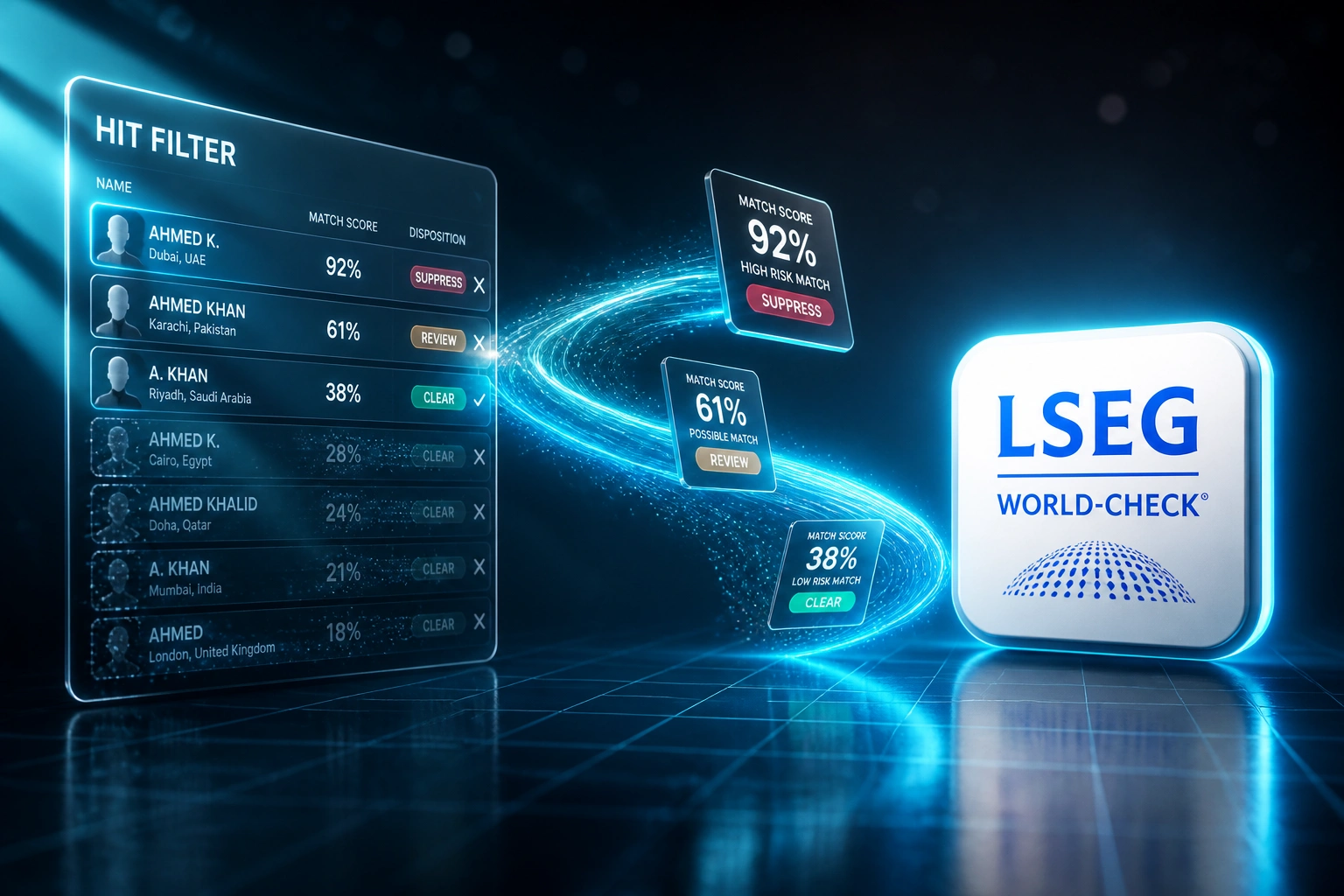
Noisy hit → filtered match → analyst review of what remains → measurable capacity back in the queue.
Hit Lands in World-Check
Onboarding or rescreen raises a name match against sanctions, PEP, or watchlist data
Filters Narrow the Match
Thresholds, secondary identifiers, and jurisdiction rules suppress known noise before triage
Analyst Reviews the Rest
The queue holds genuine possibles and true positives, not the same cleared names again
Capacity Recovered
FICA onboarding moves faster, and compliance hours go back to real investigations
Everything You Need for Screening Efficiency
Fuzzy Matching Recalibration
We retune World-Check similarity thresholds against your historical dispositions so screening efficiency rises without opening false-negative gaps.
Secondary Identifier Filters
Date of birth, nationality, ID number, and gender weight the match score so name-only coincidences drop out before an analyst opens the case.
Jurisdiction & List Scoping
Screening rules align to your RMCP: the lists and geographies that matter for your book stay in scope; noise from irrelevant programmes falls away.
Known False-Positive Suppression
Recurring cleared hits (common names, benign entities) get governed suppression with an audit trail, so the same noise never returns next week.
Risk-Tier Threshold Logic
Higher-risk customers keep stricter matching. Lower-risk books run tighter filters so capacity concentrates where controls matter most.
Measurable Hit-Volume Reporting
Before/after alert counts, false-positive rate, and average disposition time give your MLRO and board a clear view of capacity recovered.
Platforms We Tune and Connect
From 95 Alerts/Day to 40 Alerts/Day
How a mid-size South African credit provider cut World-Check false positives 58% and recovered 1.4 analyst FTEs without hiring.
The Untuned Queue
- World-Check ran on vendor-default fuzzy thresholds
- ~95 alerts per day, with a 93% false-positive clearance rate
- Average 35 minutes per Level 1 disposition
- Same common-name hits reappeared every onboarding cycle
- FICA take-on delayed while analysts cleared noise before real risk work
The Calibrated Process
- Thresholds retuned against 12 months of disposition history
- DOB, nationality, and ID filters suppressed name-only coincidences
- Known-false-positive library with governed audit trail
- ~40 alerts per day; true positives retained in back-tests
- Onboarding SLA recovered; analysts spend time on genuine possibles
Before vs After World-Check Tuning
How It Works
From queue audit to measured go-live in 3–6 weeks.
Audit Your Hit Noise
We sample your current World-Check queue: false-positive rate, disposition time, and which match patterns burn the most analyst hours.
Free Scoping Call
30-minute call to agree threshold changes, secondary-identifier rules, jurisdiction filters, and the suppression policy your RMCP will accept.
Tune & Parallel Test
We calibrate matching in a controlled environment, back-test against historical true positives, and run parallel until compliance signs off.
Go Live & Measure
Live rules replace the noisy defaults. We track hit-volume reduction and disposition time so you can prove the optimisation to examiners.
Frequently Asked Questions
Will tuning World-Check matching weaken our sanctions controls?
No. We calibrate against your historical true positives and keep detection coverage documented. Secondary identifiers and governed suppression cut name-only noise; they do not switch off sanctions or PEP lists. Every threshold change is back-tested and recorded for FIC, FSCA, and internal audit.
What typically drives World-Check false positives in South African books?
Common given names, transliteration variants, and vendor-default fuzzy thresholds that treat partial name overlap as a hit. Industry benchmarks put sanctions and PEP false-positive rates at 90–95%. Secondary identifiers already sitting in your CRM (DOB, nationality, ID) usually unlock the biggest screening efficiency gains when they are wired into matching.
How much analyst time does untuned screening waste?
Level 1 screening reviews commonly take 30–45 minutes per alert, at roughly R415–R830 in labour cost per hit once converted from industry USD benchmarks. At a 90%+ false-positive rate, most of that payroll is spent proving customers are not on a list rather than investigating real risk.
How long does a false positive reduction engagement take?
A focused World-Check tuning programme typically runs 3–6 weeks: queue audit, threshold design, parallel testing, then go-live with measurement. Broader programmes that also rework CRM case triage and known-false-positive libraries sit closer to 6–8 weeks.
Do you work with World-Check One and On Demand?
Yes. We specialise in LSEG World-Check One screening configuration and World-Check On Demand API setups. Tuning covers match thresholds, secondary identifiers, jurisdiction filters, ongoing-screening noise, and how dispositions write back to your CRM or case system.
How much does World-Check false positive reduction cost?
Focused matching and filter optimisation engagements typically start from around R45,000. Broader programmes with risk-tier thresholds, known-false-positive suppression, and CRM triage usually range from R60,000 to R120,000. Most mid-size books recover that cost within one to two months once weekly alert volume falls by half or more.
Stop Burning Payroll on World-Check False Positives
If your analysts clear the same name hits every week while FICA onboarding waits, you are paying for a tuning problem that already has a playbook.
Tell us your average daily World-Check volume, how long dispositions take, and where onboarding stalls. We will show you what calibrated matching, secondary identifiers, and known-false-positive suppression would recover for your team.