World-Check Ongoing Monitoring: Get Alerts When Client Risk Profiles Change
You already screen at onboarding. The blind spot starts on day two. Sanctions and PEP lists change constantly, point-in-time clearance goes stale, and an annual review is months too late when a client lands on a new list.
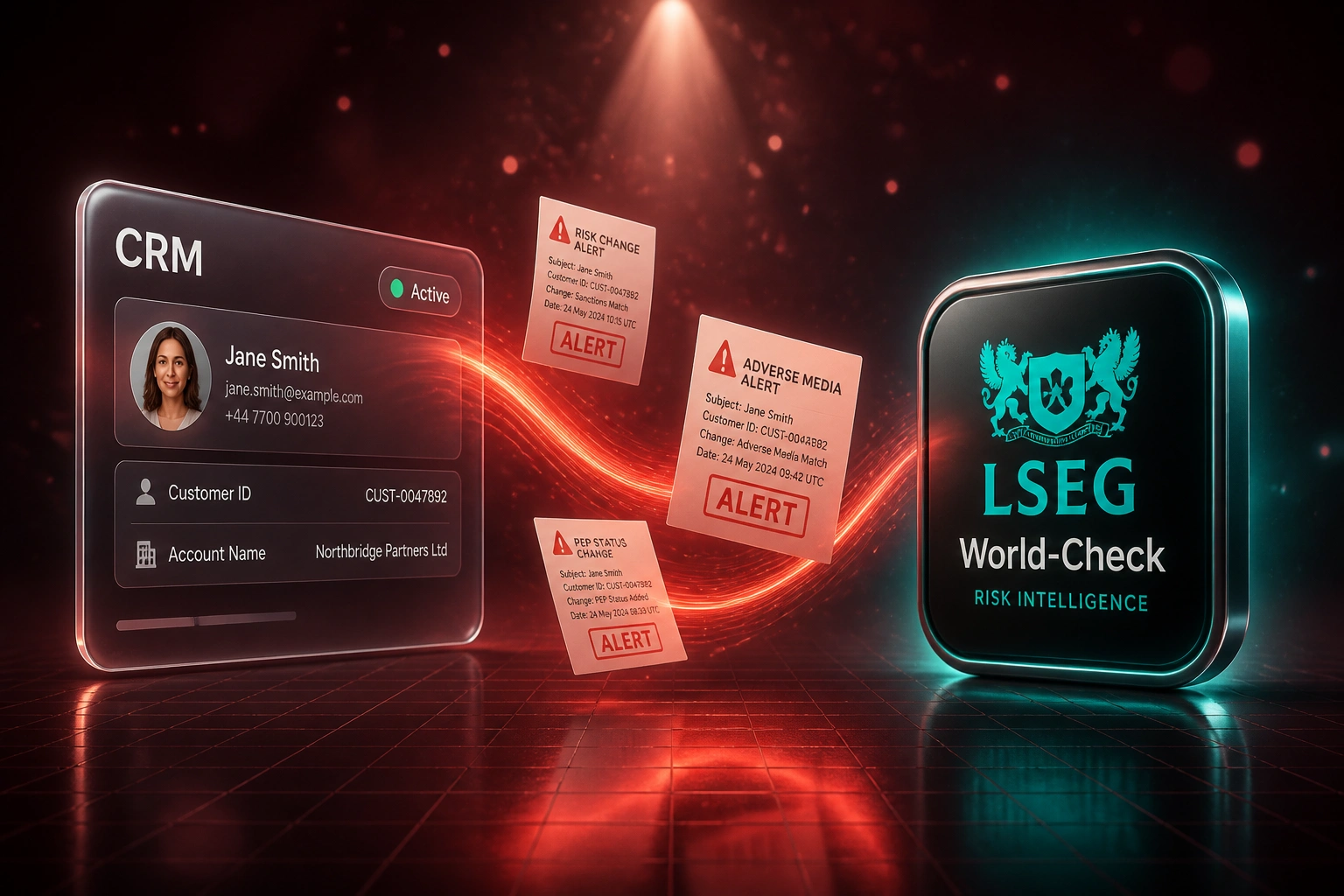
We wire World-Check continuous screening so risk-change alerts hit your case queue in hours, not at the next CDD cycle.
Sound Familiar?
These are the exact issues MLROs and compliance officers describe before continuous screening:
- Clients clear World-Check at onboarding, then sit unscreened until the next annual CDD refresh
- Sanctions and PEP lists change several times a week, so point-in-time clearance goes stale fast
- A mid-lifecycle hit only surfaces at annual review, months after the designation was published
- Compliance officers chase spreadsheet rescreens instead of reviewing a live alert queue
- FIC expects existing clients scrutinised when targeted financial sanctions lists update, not once a year
FIC PCC 44A is explicit: accountable institutions must scrutinise existing client information against the targeted financial sanctions list as and when that list is updated, not only at onboarding. Annual-only rescreening leaves a documented regulatory gap every time a high-profile designation drops mid-year.
What Continuous Screening Actually Does
Client onboarded → OGS enabled → list changes → alert in your queue. No waiting for the next annual review.
Client Clears Onboarding
Initial World-Check screen passes and the case is flagged for Ongoing Screening
Lists Change Continuously
World-Check database deltas pick up new sanctions, PEP, and watchlist updates
Alert Hits Your Queue
Risk-change notice opens a case in your CRM with match summary and review required
Act in Hours
Compliance dispositions, escalates, or exits the relationship before the next annual cycle
Everything You Need for Reliable World-Check Alerts
Ongoing Screening Enabled
Every onboarded client is flagged for World-Check Ongoing Screening so cases rescreen automatically against database deltas, not just at take-on.
Risk-Change Alert Routing
New sanctions matches, PEP status changes, and critical record updates land as cases in your CRM or case-management queue within hours.
Configurable Screening Cadence
Align OGS frequency with your RMCP: daily for higher-risk books, weekly or monthly where risk appetite allows, without rebuilding the integration.
Update Category Filtering
Surface C1 and C2 critical updates first. Lower-impact changes stay in the audit trail so analysts are not flooded with noise.
CRM Case Sync-Back
Alert status, resolution notes, and risk rating changes write back to the client record so relationship managers see the same picture as compliance.
Audit-Ready Evidence Trail
Every screen, alert, and disposition is timestamped for FIC, FSCA, and internal audit, with the list version used at the moment of screening.
Platforms We've Connected for Ongoing Monitoring
From Seven-Month Blind Spot to Same-Day Alerts
How a Johannesburg wealth FSP closed its post-onboarding monitoring gap and stopped discovering mid-lifecycle hits at annual review.
Annual Rescreen Only
- 3,400 active clients screened thoroughly at onboarding, then left until annual CDD
- Compliance ran a full-book batch once a year, taking three analysts two weeks
- A beneficial owner gained PEP status in March; the firm only saw it in October
- Seven months of unmonitored exposure on a relationship still receiving advice fees
- MLRO had no live queue: risk changes arrived as spreadsheet surprises
World-Check Ongoing Monitoring
- OGS enabled on the full book with daily cadence for high-risk and weekly for standard
- Risk-change alerts open cases in the CRM queue with match summary attached
- Same PEP status change would have surfaced within hours of the World-Check update
- Annual CDD still runs for document refresh; screening no longer waits for that cycle
- Analysts spend time on dispositions, not rebuilding rescreen spreadsheets
Before vs After Continuous Screening
How It Works
From first conversation to live World-Check alerts in 3–5 weeks.
Map Your Monitoring Gap
We review how you screen at onboarding, how often you rescreen, and where mid-lifecycle hits currently hide.
Free Scoping Call
30-minute call to design OGS enablement, alert routing into your case queue, and RMCP-aligned frequency.
Build & Parallel Test
We enable ongoing monitoring on your book, route sample alerts into your queue, and validate with compliance before go-live.
Go Live & Tune
Live alerts replace annual blind spots. We tune update categories and noise filters so the queue stays workable.
Frequently Asked Questions
How is ongoing monitoring different from screening at onboarding?
Onboarding is a point-in-time check. Ongoing Screening (OGS) keeps that case active against World-Check database deltas, so you are alerted when a cleared client later appears on a sanctions list, gains PEP status, or has a critical record update. FIC PCC 44A expects existing client information to be scrutinised when targeted financial sanctions lists update, not only at take-on.
How often does World-Check Ongoing Screening run?
Frequency is configured at group level in World-Check One: daily, weekly, monthly, or semi-annually. Cases still screen against the OGS delta of new and updated records since the last screen date. We help you set cadence by risk tier so higher-risk books check more often without drowning lower-risk books in noise.
Will continuous screening flood our compliance team with alerts?
Volume depends on book size and matching settings. Industry benchmarks put sanctions false-positive rates around 85–95%, so we configure update-category filters, secondary identifiers, and CRM triage rules so analysts see risk-change alerts that need review, not every trivial database tweak. Review time without triage often runs 30–45 minutes per alert; with routing and enrichment it drops sharply.
Does this replace our annual CDD refresh?
No. Ongoing monitoring covers sanctions, PEP, and watchlist risk-profile changes between reviews. You still refresh KYC documents and risk ratings on your RMCP schedule. The point is closing the blind spot where a designation lands in March and only surfaces at the November annual review.
Which systems can receive the alerts?
We have routed World-Check OGS alerts into HubSpot, Salesforce, Microsoft Dynamics, Zoho CRM, wealth platforms, and custom case-management systems. If your compliance queue has an API or webhook, we can land alerts there with the client record, match summary, and disposition fields your MLRO needs.
How much does a World-Check ongoing monitoring integration cost?
Typical builds that enable OGS on the existing book and route alerts into a CRM or case queue start from around R35,000. Broader programmes with risk-tier cadences, update-category filters, and bidirectional sync-back usually sit between R45,000 and R90,000. Most clients weigh that against the months-long exposure window of annual-only rescreening and recent South African FIC Act penalties running into tens of millions of rand.
Stop Waiting for Annual Review to Find Mid-Lifecycle Hits
If your clients only get rescreened once a year, every sanctions package that drops between reviews is a blind spot your MLRO cannot defend.
Tell us how you screen today, which CRM or case system holds your book, and how often you currently rescreen. We will show you exactly how World-Check ongoing monitoring alerts would land in your queue.