Zapier vs Make vs n8n: Which Automation Platform?
Your ops and marketing teams are shipping Zaps and scenarios faster than finance can track the task bill. Pick the wrong platform now and you will pay for overages every month, or fund a painful migration later.
We help you choose the right stack in Rand, then build it.
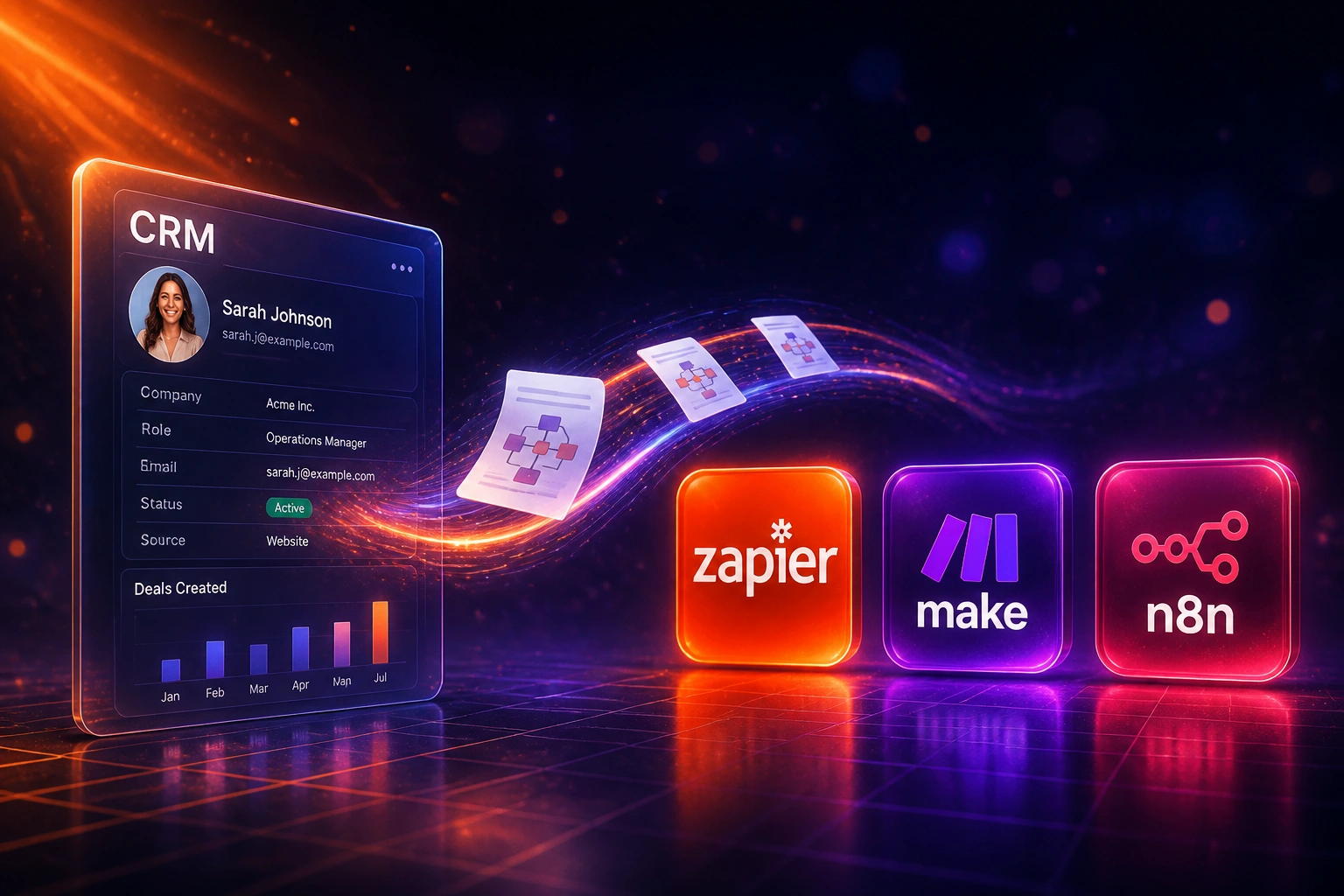
Sound Familiar?
These are the exact issues our clients faced before an honest Zapier vs Make vs n8n comparison:
- Zapier task counts climb every month because a five-step Zap burns five tasks per run
- Make credits disappear on iterators and branchy scenarios you did not budget for
- Nobody owns the automation stack, so ops, marketing, and IT each pick a different tool
- Self-hosted n8n sounded free until the VPS, backups, and who-fixes-it-at-2am question landed
- You fear a migration later more than the overages you are paying now
Zapier is changing pay-per-task rates on monthly plans from the first billing cycle on or after 15 July 2026, while Make renamed operations to credits and prices AI modules differently. If your bill is already climbing, waiting makes the migration costlier.
What a Platform Decision Actually Looks Like
Audit volume → model cost in Rand → pick Zapier, Make, n8n, or hybrid → build with ownership.
Map Real Volume
Count runs, steps, and failures across marketing, ops, and finance workflows
Price Each Platform
Zapier tasks, Make credits, and n8n executions converted to Rand at your forecast
Choose the Mix
One platform, hybrid, or custom where no-code hits a ceiling
Build & Cap Spend
Implement, monitor, and set alerts so overages never surprise finance again
Everything You Need for a Reliable Automation Stack
Honest Platform Fit
We score volume, complexity, and who will maintain the workflows. Zapier, Make, n8n, or custom: you get a clear recommendation, not a sales pitch for one vendor.
Task and Credit Modelling
We map your real runs into Zapier tasks, Make credits, and n8n executions so the Rand number on the proposal matches what finance will see in six months.
Hybrid Stack Design
Light notifications can stay on Zapier. Visual ops flows sit on Make. High-volume or compliance-sensitive work moves to n8n or a custom API path.
Self-Host TCO Clarity
If n8n self-host wins, we price the VPS, backups, monitoring, and support hours up front so "free Community" does not become a surprise ops burden.
Migration Without Drama
When a platform hits its ceiling, we migrate workflows in phases with parallel runs, so you are not rewriting everything over a weekend.
Owned Monitoring
Failed runs, overage alerts, and ownership live with your team. History and retries are designed around your SLAs, not a vendor task slider.
Platforms and Systems We Work Across
From R2,770/Month on Zapier to Under R500
How a 25-person Cape Town agency stopped task overages with a Zapier + Make + n8n hybrid.
All-In on Zapier Team
- Marketing and ops ran everything on Zapier Team at the 10,000-task tier (~R2,770/month annual)
- Multi-step lead and fulfilment Zaps burned 4–6 tasks per run
- Monthly overages at 1.25× the base task rate after busy campaign weeks
- No owner for failed runs; Zap History became a part-time job
- Finance only saw the bill after the damage was done
Right Tool Per Workflow
- Light notifications stayed on a small Zapier plan
- Visual branching and campaign ops moved to Make Core (~R197/month for 10,000 credits)
- High-volume CRM↔warehouse sync moved to self-hosted n8n Community on a ~R250/month VPS
- Owned monitoring and alerts replaced surprise invoices
- Clear runbook for who fixes what when a flow fails
Before vs After an Honest Platform Comparison
How It Works
From first conversation to a capped, owned automation stack in 2–6 weeks.
Audit Your Stack
Current Zaps, scenarios, and scripts: volume, failure rate, and who actually maintains them.
Compare in Rand
Side-by-side Zapier vs Make vs n8n (cloud and self-host) against your forecasted run volume.
Build the Right Mix
We implement on the winning platform(s), harden error handling, and document ownership.
Go Live & Cap Cost
Parallel test, cut overages, and set alerts so the next volume spike never surprises finance.
Frequently Asked Questions
What is the difference between Zapier tasks, Make credits, and n8n executions?
Zapier charges per action: a five-step Zap uses five tasks every time it runs. Make charges one credit per module action in a scenario (formerly called operations). n8n charges one execution for a full workflow run, no matter how many steps. That single difference is why multi-step marketing and ops flows often look cheap on Zapier at first and expensive at scale.
How much do Zapier, Make, and n8n cost in Rand?
At about R16.40 per US dollar and R19 per euro (mid-2026 rates): Zapier Professional starts around R330/month annually for 750 tasks; Team around R1,130/month for 2,000 tasks; 10,000 tasks on Professional is about R2,115/month. Make Core is about R197/month annually for 10,000 credits; Pro about R344; Teams about R623. n8n Cloud Starter is about R380/month for 2,500 executions; Pro about R950 for 10,000. Self-hosted n8n Community is free software plus VPS and maintenance (often R80–R500/month for hosting alone).
When should a South African SME pick Zapier?
When volume is light, workflows are short, and speed-to-ship matters more than per-run cost. Under roughly 1,000–2,000 tasks a month with simple two-to-three step Zaps, Zapier's app library and ease of use usually win. Past that, model the multi-step tax carefully before you lock in.
When does Make beat Zapier?
When you need visual branching, routers, and more operations per Rand. Make's Core plan at about R197/month for 10,000 credits is often far cheaper than Zapier at a similar action volume. Watch iterators and AI modules: they consume credits faster than a simple linear scenario.
Is self-hosted n8n actually free?
The Community edition software is free, but total cost of ownership is not. Budget for a VPS (often R80–R500/month), backups, updates, and someone who can fix a downed worker. Business features (SSO, Git environments) need a paid licence: Business starts around R12,670/month for 40,000 executions on annual billing. For many SMEs, n8n Cloud Pro at about R950/month is the cleaner path until volume or data residency forces self-host.
Can WebFootprint implement on any of the three, or build custom instead?
Yes. We implement and harden workflows on Zapier, Make, and n8n, design hybrid stacks, and build custom API integrations when platform ceilings, SA tax rules, or bidirectional sync requirements make no-code the expensive option. Advisory and build engagements typically start from around R15,000 for a focused platform decision plus light implementation, with fuller hybrid or custom builds in the R25,000–R60,000 range.
Stop Guessing Which Automation Platform to Bet On
If your team is still picking Zapier, Make, or n8n by habit, you are paying for convenience with overages or locking into a stack you will outgrow.
Tell us your current tools, monthly run volume, and what is causing the most friction. We will show you a Zapier vs Make vs n8n comparison in Rand for your workflows, and recommend custom where the platforms hit their ceiling.